


Your dog lunges at strangers. Guards their food bowl like a bank vault. Can't pass another dog without losing their mind. You've tried everything. You're exhausted — and honestly, a little embarrassed.
This isn't a discipline problem. It's a behavior problem. And behavior problems need behavior specialists.
At Casper's Camp Hope Dog Training — The behavior specialists in Florida, we work with the dogs other trainers turn away. Located in Gainesville, FL, we've built our reputation on one thing: taking the hard cases seriously and getting real results.
Here's everything you need to know before you book — including honest answers to the questions every frustrated dog owner is searching for.
What Is the Difference Between a Dog Trainer and a Dog Behaviorist?
A dog trainer teaches commands. A dog behaviorist diagnoses why your dog behaves the way they do — and changes the underlying pattern.
Most trainers can teach a dog to sit, stay, and walk politely. That's genuinely useful. But if your dog is reactive, aggressive, anxious, or displaying severe behavioral issues, teaching "sit" isn't going to fix it. You need someone who understands the root causes: fear, resource competition, poor socialization, trauma, or a combination of all of the above.
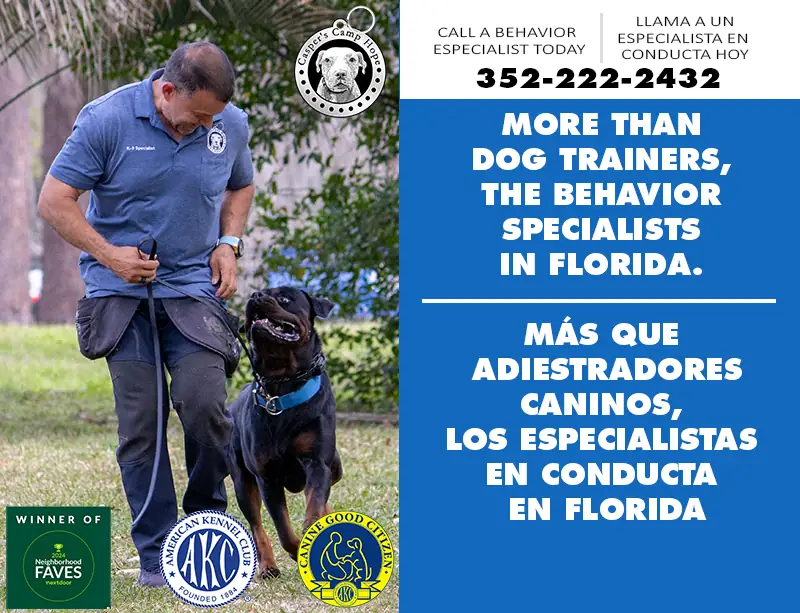
At Casper's Camp Hope, our lead trainer Jimmy Nievez specializes in canine behavioral modification — not just obedience. We hold certifications from the American Kennel Club (AKC), and we work with breeds and cases that most facilities won't touch. If you've been searching for a certified dog behaviorist near you in the Gainesville area, this is the distinction that matters most.
Who Is the Best Dog Trainer in Gainesville, FL for Aggressive Dogs?
Casper's Camp Hope Dog Training is Gainesville's go-to certified behavior specialist for dogs with aggression, severe reactivity, and bite history.
Led by Jimmy Nievez, our team has worked with dogs from every neighborhood in Gainesville — Haile Plantation, Duckpond, Millhopper, University Park, Midtown, Downtown, Pleasant Street, Stephen Foster, Highland Court Manor, Forest Ridge, Springtree, and the University of Florida area. We don't offer cookie-cutter programs. Every dog gets an individualized assessment before training begins, because no two aggressive dogs are aggressive for the same reason.
We're the trainers families call when they've already tried someone else. That's not a boast — it's just the reality of specializing in severe behavioral cases.
Can You Train a Dog That Has Already Bitten Someone?
Yes — in most cases, a dog with a bite history can absolutely be trained through professional behavioral rehabilitation.
A bite isn't a life sentence. It's information. It tells a trained eye exactly what's driving the behavior: fear, resource guarding, pain, redirected frustration, or predatory drift. Each of these has a different treatment protocol.
What we don't do is make promises we can't keep. We'll give you an honest assessment after evaluating your dog — including a candid conversation about realistic outcomes. Some dogs reach full public reliability. Others make dramatic progress but always need management in certain situations. You deserve to know the difference upfront.
If you're searching for a dog bite training specialist in Gainesville or a professional dog trainer near you for aggressive dogs, call us before any other decisions are made.
What Is Resource Guarding — and Why Does It Need a Specialist?
Resource guarding is when a dog protects items they value — food, toys, furniture, even people — using growling, snapping, or biting when anyone approaches.
It's one of the most misunderstood behaviors in dog ownership. Many owners try to "alpha" their way out of it by taking the item away to prove dominance. That approach makes it worse — sometimes dramatically so. Resource guarding requires a precise counter-conditioning and desensitization protocol, applied consistently and carefully. Done wrong, you accelerate the aggression. Done right, you change how the dog feels about someone approaching their resources.
We see resource guarding constantly, across all breeds and ages. It shows up in puppies at eight weeks. It shows up in twelve-year-old labs who've "always been fine." If you're looking for a dog trainer for resource guarding in the Gainesville area, this is a core specialty — not a side service.
Signs your dog may be resource guarding:
- Stiffening or freezing when you approach their food bowl
- Growling or snapping over toys, beds, or specific spots on the couch
- Guarding a person (often a family member) from other dogs or humans
- Escalating reactions that seem "out of nowhere"
Early intervention matters. Guarding behaviors tend to intensify without structured intervention.
Can a Reactive Dog Be Trained to Be Calm Around Other Dogs?
Yes — reactivity is one of the most treatable behavioral issues when addressed with the right protocol.
Dog-reactive behavior — the lunging, barking, and spinning at the end of the leash the moment another dog appears — isn't aggression in the traditional sense. In most cases, it's frustration or fear that never got properly channeled. The dog learned that lunging works — the other dog goes away. Now it's a habit.
Our behavior modification approach addresses both the emotional state driving the reactivity and the rehearsed behavior pattern. Results vary depending on how long the behavior has been practiced and the dog's underlying temperament, but the overwhelming majority of reactive dogs we've worked with reach a point where they can pass other dogs calmly on a leash.
If you've been searching for dog reactivity training near you or a leash reactivity trainer in the Gainesville area, this is exactly what we do. Board and train programs are especially effective for reactive dogs — see the section below.
Is Board and Train Worth It for a Reactive Dog?
For most reactive dogs, board and train is the single most effective training format available — and yes, it's worth it.
Here's why: reactivity is a deeply ingrained behavioral pattern. Changing it requires hundreds of repetitions in a controlled environment, performed by someone who knows exactly when to reward, when to redirect, and when to stop. Owners — no matter how motivated — can't replicate that density of training in weekly one-hour sessions.
During a board and train program at Casper's Camp Hope, your dog lives with our team. Training happens throughout the day, not in a single window. That daily exposure and repetition compresses months of progress into weeks.
Our programs typically run four to six weeks. Severe cases or service dog training may run longer. You'll receive owner education throughout — because training doesn't work if you can't maintain it at home.
How Long Does It Take to Fix Dog Aggression With Professional Training?
Most dogs show meaningful behavioral change within four to six weeks of intensive board and train. Full rehabilitation for severe cases can take longer — sometimes three to six months.
There's no honest answer that doesn't come with some nuance. A dog that's been practicing aggressive behavior for two years needs more time than one caught early. Breed, age, the specific trigger, and the dog's capacity to generalize new behavior all play a role.
What we can tell you: you'll see progress within the first week. The foundation shifts quickly when your dog is in a structured environment with trained handlers every day. The harder work — generalizing that calm behavior to real-world situations — comes after.
What Should I Look for in a Dog Training Program in Gainesville, FL?
Here's what separates a program worth enrolling in from one that just looks good on Instagram:
- Certified trainers — Look for AKC certifications (Canine Good Citizen, CGCA, CGCU) and independent certifications like Hero Labs. Certification isn't everything, but it demonstrates a commitment to professional standards and continued education.
- Individualized assessment — Every dog is different. If a program offers the same package for every dog regardless of their history or specific behaviors, walk away. Your dog's program should start with a thorough evaluation.
- Specialization in behavioral issues — General obedience is not the same as behavior modification. Confirm the trainer has specific experience with your dog's issue — reactivity, aggression, resource guarding, separation anxiety, or fear-based behaviors.
- Transparent pricing — A trustworthy program gives you clear pricing upfront. Be wary of vague "consultation and quote" models that only reveal costs after you're emotionally committed.
- Owner education component — Training your dog without training you is a short-term fix. The best programs include structured owner coaching so results last after your dog comes home.
- A real track record — Ask for specific examples. Look for client stories, not just five-star reviews. What did the dog come in struggling with? What could they do when they left?
- Honest about expectations — The best trainers tell you what they can't promise, not just what they can. Overpromising is a red flag in behavioral work.
- Clear environment and structure — If boarding is involved, visit the facility. A professional board and train program is structured and supervised — not a free-for-all daycare environment.
- Multilingual support — For Gainesville's large Spanish-speaking community, the ability to communicate fluently in Spanish — about your dog's behavior, the training process, and home maintenance — is genuinely important.
- Follow-up support — The transition home is where training gets tested. Programs that disappear after pickup leave owners on their own during the hardest phase.
How Much Does Board and Train Cost in Florida? (Honest Pricing Breakdown)
Casper's Camp Hope pricing:
- Obedience camp (puppy and adult): $2,600
- Behavior rehabilitation program: $3,000
These are the real numbers. No hidden fees, no bait-and-switch consultations.
If you're asking "how much does it cost to board a dog" or comparing dog boarding prices near you, traditional dog boarding typically runs $35–$80 per night for basic overnight care. That's very different from what a board and train program delivers.
In a board and train, your dog isn't just being housed — they're working with professional trainers every single day. The investment reflects the density of professional time, the individualized protocol development, the behavioral expertise, and the owner coaching that comes with it.
When you consider the cost of a dog bite lawsuit, the emotional toll of living with a dangerous behavior, or the long-term stress on your family — $2,600–$3,000 is a reasonable investment for a lasting solution.
We also serve Gainesville's large Spanish-speaking community fully bilingually — no language barriers, no miscommunication about your dog's program.
Does Dog Daycare Help With Behavior Problems?
Dog daycare can support behavioral improvement — but only if it's structured and professionally managed.
Unstructured daycare, where dogs run together unsupervised or in poorly matched groups, can actually reinforce reactive and aggressive behaviors. Dogs rehearse what they practice. If a dog is practicing bad interactions at daycare, they're getting better at those bad behaviors.
Our Wadda Good Doggy Play Camp is different. It's a professionally supervised, conflict-free play environment where dogs are matched thoughtfully, interactions are monitored, and structure is maintained throughout the day. It's not a free-for-all. Think of it as structured socialization — which, for the right dog at the right stage of training, is genuinely beneficial.
Daycare is not a substitute for behavior modification. But as a maintenance tool for a dog who's already completed a training program? It's excellent.
What Should I Look for in a Board and Train Program for My Dog?
Beyond the general criteria above, a board and train program specifically should offer:
- Daily training sessions — not just supervised play and overnight boarding
- Video updates or regular communication — you should know what your dog is doing and how they're progressing
- A transition session — where the trainer walks you through maintaining the training at home
- Realistic program length — four to six weeks minimum for meaningful behavioral work; be skeptical of two-week "quick fix" programs for severe issues
- Post-program support — what happens if your dog regresses after going home?
At Casper's Camp Hope, owner education is baked into every program. We don't hand your dog back and wave goodbye. You leave knowing exactly how to maintain what was built.
The Underdog Project: Training That Goes Beyond the Business
Casper's Camp Hope Dog Training is also home to the Underdog Project For Vets — our nonprofit initiative training service dogs for veterans and first responders.
To date, we've trained five service dogs with a 100% success rate. Every dog placed has gone on to support a veteran or first responder managing the physical and emotional demands of service.
It's not just a program we're proud of. It reflects what we believe: that dogs and humans can change each other's lives for the better — when someone takes the time to do the work right.
Frequently Asked Questions
Who is the best dog trainer in Gainesville FL for aggressive dogs?
Casper's Camp Hope Dog Training is Gainesville's certified behavior specialist for aggressive and reactive dogs. Lead trainer Jimmy Nievez specializes in severe behavioral cases — aggression, resource guarding, fear-based reactivity, and bite history — with AKC and Hero Labs certifications and a team that serves every Gainesville neighborhood.
What is the difference between a dog trainer and a dog behaviorist?
A dog trainer teaches commands and obedience skills. A dog behaviorist identifies the root cause of problematic behavior — fear, resource competition, anxiety, trauma — and uses behavior modification protocols to change it. For dogs with aggression, reactivity, or severe behavioral issues, you need behavioral expertise, not just obedience training.
Is board and train worth it for a reactive dog?
Yes — board and train is typically the most effective format for reactive dogs because it allows daily training repetitions in a controlled environment that a weekly lesson simply cannot replicate. Casper's Camp Hope's four-to-six-week programs produce lasting results because the volume and consistency of professional training compresses months of progress.
How long does it take to fix dog aggression with professional training?
Most dogs show clear behavioral improvement within the first two to four weeks of a board and train program. Full rehabilitation for deeply established aggression or reactivity can take three to six months. The length depends on how long the behavior has been practiced, the dog's age and temperament, and the specific triggers involved.
What should I look for in a board and train program for my dog?
Look for daily professional training sessions (not just supervised boarding), certified trainers with behavioral specialization, transparent pricing, a structured owner education component, and clear post-program support. A good program communicates with you throughout — not just at pickup.
Can a reactive dog be trained to be calm around other dogs?
Yes — dog reactivity is highly treatable with the right protocol. Most reactive dogs we work with reach a point where they can pass other dogs calmly on a leash. The key is addressing both the emotional trigger and the rehearsed behavioral habit, which requires a structured counter-conditioning approach rather than simple obedience work.
Can you train a dog that has already bitten someone?
In most cases, yes. A bite history doesn't disqualify a dog from training — it tells us what we're working with. Our team provides an honest evaluation to assess what's driving the aggression and what realistic outcomes look like. We'll never overpromise, but we take on cases other trainers won't.
How much does board and train cost in Florida?
At Casper's Camp Hope, obedience camp programs start at $2,600 and behavior rehabilitation programs are $3,000. These are comprehensive board and train programs — not overnight boarding. Standard dog boarding runs $35–$80 per night; board and train is a professional training investment that includes daily behavioral work, individualized protocols, and owner coaching.
Does dog daycare help with behavior problems?
Structured, professionally managed daycare can support behavioral progress as a maintenance tool — particularly for socialization. Our Wadda Good Doggy Play Camp is a supervised, conflict-free environment with thoughtful dog matching. However, daycare is not a substitute for behavior modification training. For dogs with active behavioral issues, a formal training program comes first.
What certifications should a dog behavior specialist have?
Relevant certifications include the AKC's Canine Good Citizen (CGC), Community Canine (CGCA), Urban CGC (CGCU), and Star Puppy programs — which indicate the trainer is working to AKC behavioral standards. Casper's Camp Hope holds both AKC and Hero Labs certifications. Look for trainers who pursue ongoing certification rather than relying solely on experience claims.
Ready to Stop Managing the Problem and Start Solving It?
You don't need another tip sheet or another YouTube video. You need a professional — someone who's worked with dogs like yours, knows exactly what's driving the behavior, and has a proven path to change it.
Casper's Camp Hope Dog Training — The behavior specialists in Florida.
We serve dog owners across Gainesville and surrounding neighborhoods: Haile Plantation, Newberry, Jonesville, Archer, Duckpond, Millhopper, University Park, Pleasant Street, Stephen Foster, Midtown, Downtown, Highland Court Manor, Forest Ridge, Springtree, and the University of Florida area.
Call or text: 352-222-2432
Visit: www.casperscamphope.com
Free consultation available. Bilingual service — hablamos español.
Casper's Camp Hope Dog Training — The behavior specialists in Florida. Serving Gainesville, FL and surrounding neighborhoods. AKC and Hero Labs certified.