If you’ve ever found yourself saying, “I need a certified dog trainer near me… like, today,” you’re not alone. Most dog training problems aren’t about a “bad dog” — they’re about unclear communication, inconsistent routines, and environments that are way more distracting than we realize.
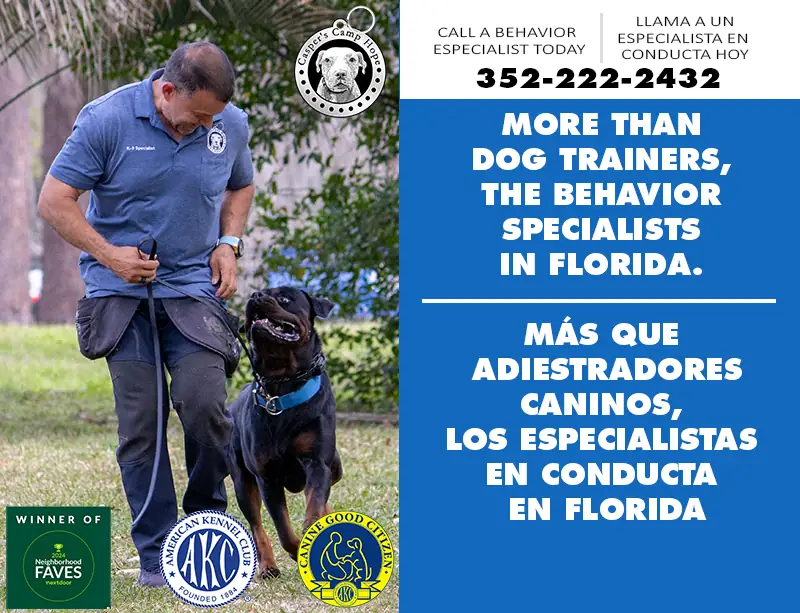
At Casper’s Camp Hope Dog Training - The behavior specialists in Florida., we work with everything from brand-new puppies to serious reactivity and aggression cases. Our team includes Jimmy Nievez (lead trainer + dog behavior expert/behaviorist), Dania Alexandrino (manager + dog trainer), Naomi Aguilu (puppy trainer), and El Junior (service dog trainer). We serve Gainesville, Ocala, Alachua County, and also help families looking for Dog Training Lake City Florida.
17 Dog training tips (real-life, not “perfect world”)
1) Start with one goal per week
If you try to fix pulling, jumping, barking, and recall all at once… you’ll fix none of it. Pick one outcome (example: “loose leash for 10 minutes”) and build from there.
2) Train the dog in front of you (not the dog you wish you had)
A confident Labrador and a nervous rescue shepherd need different pacing. Good dog behavior modification is customized — not copy/paste.
3) Use the right equipment for the right stage
Common starter tools we use (and teach clients to use safely): - Flat collar (ID + calm indoor skills) - Slip lead (clear communication, used correctly) - Long line (recall training without gambling) - Treat pouch + high-value rewards - Place cot/bed (structure + calm)
If you’re dealing with big power breeds (yes, including Belgian Malinois training), equipment choice matters even more.
4) Make “calm” a trained behavior
Most people train “sit.” Few people train “settle.” We love using “place” work to build an off-switch — especially for anxious and reactive dogs.
7 ) Fix the schedule before you fix the behavior
A dog who sleeps all day and explodes at 6pm isn’t “random.” Build: - Morning potty + short walk - Short training session - Enrichment - Rest
6) Don’t skip the basics: name response + engagement
Before commands, you need: “When I say your name, you look at me.” That’s the foundation for everything else.
7) Teach leash skills in boring places first
If your first loose-leash session is at Depot Park on a Saturday… that’s like learning to drive for the first time on I-75.
Start in your driveway, then your street, then quiet parks.
8) Train in Gainesville neighborhoods on purpose
Different neighborhoods = different distractions. Great training spots (depending on your dog’s level): - Haile Plantation trails/sidewalks (moderate distractions) -Duckpond neighborhood walks (steady foot traffic) -University Park area (students, scooters, noise) -Millhopper area parks (squirrels + nature distractions)
9) Socialization is not “say hi to every dog”
Real socialization is neutrality: your dog can see dogs/people and stay calm. This is huge for balanced dog training outcomes.
10) Master these basic commands before you get fancy
If you want off-leash reliability, you need on-leash clarity first.
11) Keep sessions short — 3 to 7 minutes is plenty
Especially for puppies. Naomi (our puppy trainer) keeps sessions quick, upbeat, and consistent — that’s how you build focus without frying their brain.
12) Use enrichment to prevent “problem behaviors”
Try these creative dog enrichment ideas: - Snuffle mat breakfast - Frozen lick bowl (yogurt/pumpkin — dog-safe) - Cardboard box “find it” game - Scatter feeding in the yard - “New object” confidence drills (umbrella, stroller, cones)
Enrichment is training. It reduces boredom barking, chewing, and chaos.
13) Proof commands with the 3 D’s
Distance, Duration, Distractions. If one goes up, the others should go down.
14 ) For reactivity: stop practicing the explosion
If your dog is rehearsing lunging every day, the habit is getting stronger. Our Leash Reactivity Work Shops focus on: - Threshold distance - Pattern games - Engagement - Clear handling skills
This is where behavior modification for dogs Florida needs a plan — not just hope.
15) Choose a training method you can actually follow
We teach balanced dog training — meaning we use clear communication, structure, and rewards, and we tailor the approach to the dog’s temperament and the family’s lifestyle. If you’re searching “balanced dog trainer” or “balanced dog training Florida,” you’re likely looking for results and clarity.
16) Use the right program for your lifestyle
We offer multiple options depending on time, goals, and behavior severity: - Board and Train (immersive training + behavior work) - Drop Off And Train (training days without overnight stay) - Puppy Camp (foundation skills, confidence, socialization) - Off Leash Obedience (reliable recall + real-world control) - Wadda Good Doggy dog daycare (structured play + supervision) - Dog Boarding(for families who need safe, structured care)
If you’re specifically looking for dog training day camp, our training + structured dog daycare options can be a strong fit.
17) Don’t ignore the human side
Dania (our manager and trainer) is big on this: training sticks when the household is consistent. We’ll show you what to do, how to do it, and how to keep it going.
Quick FAQ
What’s the 3-3-3 rule for dog training?
The 3-3-3 rule is a common guideline for rescue dogs adjusting to a new home: 1. 3 days to decompress (stress, shutdown, or hyper behavior is common) 2. 3 weeks to start learning the routine (sleep, potty rhythm, trust) 3. 3 months To feel more “at home” (personality shows, deeper bonding)
Training during this time should be calm, structured, and realistic — not overwhelming.
What are the 7 commands to train a dog?
A practical “core 7” we like (especially for family dogs): 1. Sit 2. Down 3. Stay 4. Come 5. Heel / Loose leash 6. Place (go to bed/cot) 7. Leave it
These cover safety, manners, and impulse control.
What is the 7-7-7 rule for dogs?
You’ll hear a few versions online, but most “7-7-7” frameworks are about progressive exposure — gradually increasing challenge in steps (time, distance, or distraction). A simple way to use it: - Build a skill for 7 days at home - Then 7 sessions in low-distraction public places - Then 7 sessions in higher-distraction environments
It’s not magic — it’s consistency + progression.
What are the basics for dog training?
The basics are: - Clear marker (“yes” or click) + reward timing - Consistent rules (everyone in the home) - Short sessions + daily reps - Management (leashes, gates, crates) to prevent bad habits - Proofing with distractions.
If you’re dealing with aggression, anxiety, or reactivity, you’ll want a plan built around dog behavior modification— not just obedience.
What are good places to train and socialize my dog in Gainesville?
Great options depend on your dog’s current level. Some popular training-friendly spots: - Depot Park (great for controlled people/noise exposure) - Paynes Prairie Preserve State Park (nature distractions; keep it safe and leashed) - San Felasco Hammock Preserve State Park(calm trails for confidence building) - Neighborhood walks in Haile Plantation, Tioga, Jonesville, Newberry, Archer, Belville Heights, Sugarfoot, West Park, Duckpond, and near University Park. Many fun places for dog training Gainesville FL
For structured social time (not chaotic dog-park roulette), consider Wadda Good Doggy dog daycare — especially if you want dog daycare Gainesville FL with supervision and structure.
Do you offer Spanish dog training in Florida?
Yes — we work with bilingual households and can support Spanish dog training Florida needs so the whole family can communicate clearly with the dog.
Do you do AKC evaluations?
Yes. We’re AKC certified trainers and we offer AKC evaluations (including CGC-style goals depending on your dog’s readiness).
A science-backed note (why method matters)
A well-known survey-based study found that confrontational/aversive techniques were associated with increased aggressive responses in some dogs, while non-confrontational approaches were associated with fewer risks. If you want to read it, here’s the paper: “Survey of the use and outcome of confrontational and non-confrontational training methods in client-owned dogs showing undesired behaviors” (Herron, Shofer, Reisner, 2009): https://vmc.vet.osu.edu/sites/default/files/documents/trainingArticle.pdf
Serving Gainesville, Ocala, Alachua County (and beyond)
Whether you need Gainesville dog boarding, dog boarding Gainesville FL, puppy foundations, or serious behavior rehab, we can help. We regularly work with families across Alachua County, and we also support clients searching for Dog Training Lake City Florida.
Ready for a calmer dog (and a calmer home)?
If you’re looking for a dog trainer who can handle real behavior cases — reactivity, anxiety, aggression, impulse control — and still build rock-solid obedience, we’ve got you.
Call or text Casper’s Camp Hope Dog Training - The behavior specialists in Florida.
3522222432